
The 30-Day Cat Challenge: One Small Activity a Day for a Happier, Healthier Cat
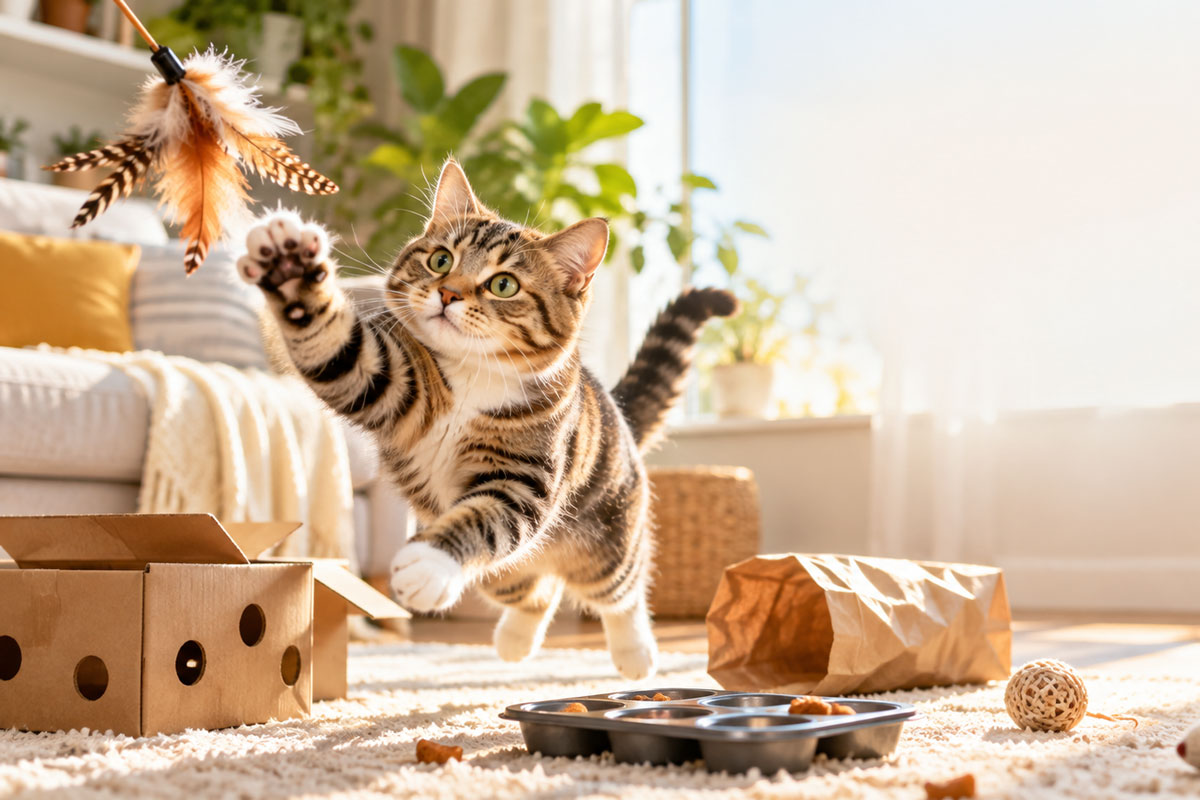
A month-long calendar of play ideas, treat-hunting games, shared relaxation, and easy enrichment tasks you can do with everyday household items.
If your cat spends most of the day napping on the couch, staring out the window, or yowling at 4 a.m., you are not alone. Indoor cats are safe, but safety can come with a hidden cost: boredom. Without enough mental and physical stimulation, many cats gain weight, develop stress-related behaviors, or start redirecting their energy toward your curtains and ankles.
The good news is that you do not need an expensive gadget or an hour of free time. You need a few minutes a day and a little creativity. This 30-day cat challenge gives you one small, doable activity for every day of the month, mixing interactive play, treat-search games, quiet time together, and simple environmental enrichment for cats.
Key Takeaways
- Ten to fifteen minutes a day of structured activity can noticeably improve a cat’s mood, weight, and behavior.
- The best cat enrichment engages the hunting sequence: stalk, chase, pounce, catch, and eat.
- Treat-hunting games (scent games) are among the easiest ways to tire out a cat’s brain.
- Shared rest matters as much as play, because it builds trust and lowers stress.
- Always follow your cat’s lead. If your cat hides, flicks its tail, or walks away, stop and try something gentler tomorrow.
Why a 30-Day Challenge Works for Cats
Cats are natural predators. In the wild, a cat might hunt ten or more small prey animals a day, and each hunt follows a predictable pattern. Most indoor cats get food from a bowl in five seconds flat, which skips the whole sequence. Daily enrichment replaces what your cat’s instincts are asking for.
A challenge format helps for three reasons:
- Consistency beats intensity. Short daily sessions build routine, and cats thrive on predictability.
- Variety prevents boredom. Rotating activities keeps novelty high, so your cat does not lose interest.
- It helps you learn your cat. By the end of the month, you will know which games your cat loves, which it ignores, and what time of day it is most playful.
Research and veterinary behaviorists consistently link enrichment to lower stress and fewer problem behaviors. It will not replace veterinary care, but it is one of the most effective free or low-cost ways to improve your cat’s quality of life.
Before You Start: Set Yourself Up for Success
Gather a Few Basics
You do not need much. Most of the 30 days use items you already own:
- A wand toy (feather, ribbon, or fabric lure on a stick)
- Small, soft treats or a portion of your cat’s regular kibble
- Cardboard boxes, paper bags (handles removed), and paper towel tubes
- A puzzle feeder or muffin tin (optional)
- A soft blanket and a quiet corner
- A few ping-pong balls or crinkle balls
Follow These Ground Rules
- Keep sessions short. Five to fifteen minutes is plenty. Many cats prefer several mini sessions to one long one.
- Count treats as food. Subtract them from your cat’s daily meals so the challenge supports weight management instead of undermining it.
- Supervise string, ribbon, and yarn. Swallowed string can cause serious intestinal emergencies. Put these toys away when play ends.
- Check the safety of every object. Remove anything small enough to swallow, and avoid toxic plants and essential oils.
- Let your cat opt out. Enrichment should be a choice, never a forced event.
If your cat has a medical condition, is a senior, or suddenly acts lethargic or aggressive, talk to your veterinarian first.
The 30-Day Cat Challenge Calendar
Want to follow along offline? Download the free printable 30-day cat challenge calendar, stick it on your fridge, and tick off each activity as you go.
Download the free printable calendar (PDF)
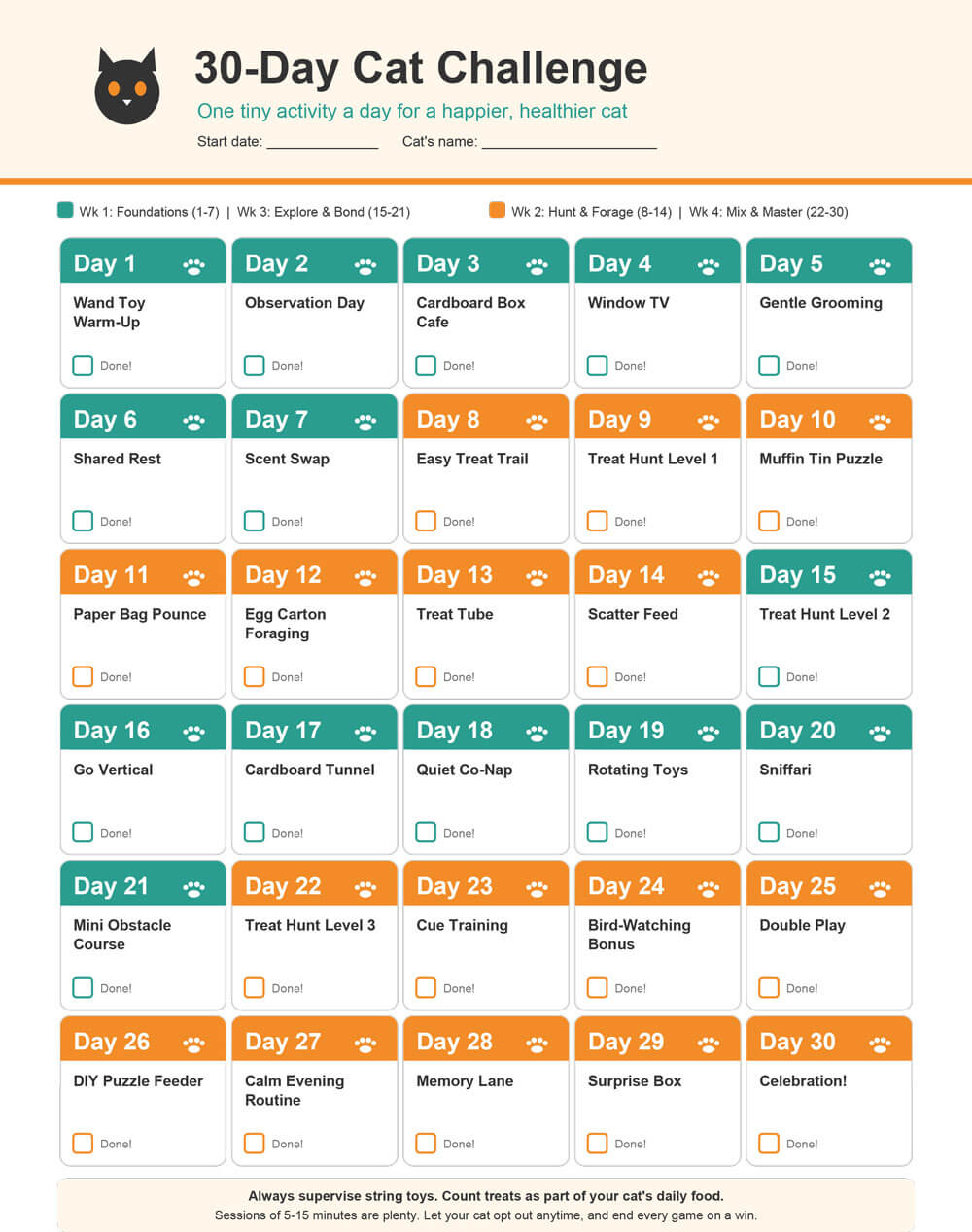
The calendar is organized into four weeks, each with a theme. Feel free to swap days around to match your schedule and your cat’s mood.
Week 1: Foundations (Days 1-7)
This week is about building trust, learning your cat’s preferences, and establishing a daily rhythm.
- Day 1: Wand Toy Warm-Up. Drag a wand toy along the floor like prey that is trying to escape, not dangling in the air. Let your cat catch it at the end for a satisfying win.
- Day 2: Observation Day. Watch your cat for ten minutes without interacting. Note favorite sleeping spots, play times, and what catches its attention.
- Day 3: Cardboard Box Cafe. Place an open box on the floor with a few treats inside. Boxes provide security, which many cats find deeply comforting.
- Day 4: Window TV. Set up a cozy perch by a window and open the blinds. If you can, add a bird feeder outside for a long-lasting nature show.
- Day 5: Gentle Grooming Session. Use a soft brush for a few minutes, only on areas your cat enjoys, such as cheeks and the base of the back.
- Day 6: Shared Rest. Sit on the floor with a book or your phone while your cat does its own thing nearby. Simply being present counts as bonding.
- Day 7: Scent Swap. Rub a clean sock on your cat’s cheeks, then leave it near a favorite spot. Cats communicate through scent, and familiar smells build confidence.
Week 2: Hunt and Forage (Days 8-14)
Now we lean into natural instincts, with food-based games that put your cat’s nose and brain to work.
- Day 8: Easy Treat Trail. Place five treats in a line across one room, in plain sight. This introduces the idea that searching is rewarding.
- Day 9: Treat Hunt, Level One. Hide five to eight treats in easy, visible spots: on a low step, beside a chair leg, on the edge of a rug. Say a cue word like “find it” as your cat searches.
- Day 10: Muffin Tin Puzzle. Put treats in a few cups of a muffin tin and cover some with crinkle balls. Your cat must paw out the prizes.
- Day 11: Paper Bag Pounce. Lay a paper bag on its side with the handles removed. Toss in a treat or scratch the outside to spark curiosity.
- Day 12: Egg Carton Foraging. Hide dry treats in the cups of a cardboard egg carton and close the lid loosely.
- Day 13: Toilet Paper Roll Treat Tubes. Fold the ends of a cardboard tube, drop in a few treats, and let your cat bat it around.
- Day 14: Scatter Feed. Sprinkle part of a meal across a small area, or on a snuffle mat, so your cat eats the way it would hunt: slowly, piece by piece.
Week 3: Explore and Bond (Days 15-21)
This week adds vertical space, novelty, and quality time.
- Day 15: Treat Hunt, Level Two. Hide treats in harder places: under a blanket edge, behind a pillow, on a low shelf. Always keep it achievable.
- Day 16: Go Vertical. Offer a safe, stable high spot, such as a sturdy shelf or cat tree. Cats feel safer when they can survey their territory from above.
- Day 17: Cardboard Tunnel. Connect two boxes with open ends, or tape a few together. Lure your cat through with a wand toy.
- Day 18: Quiet Cuddle or Co-Nap. Rest on the couch with a blanket and invite your cat to join, without forcing it. Shared rest helps both of you unwind.
- Day 19: Rotating Toy Day. Hide all toys, then bring out three your cat has not seen recently. Rotation makes old toys feel new.
- Day 20: Sniffari. Bring in a safe new smell: a dried leaf, a clean cardboard scrap from outside, a bit of catnip, or silvervine. Let your cat investigate at its own pace.
- Day 21: Mini Obstacle Course. Arrange pillows, a box, and a blanket tunnel, then guide your cat through with a lure toy.
Week 4: Mix and Master (Days 22-30)
In the final stretch, combine what you have learned and fine-tune your cat’s favorites.
- Day 22: Treat Hunt, Level Three. Hide treats in multiple rooms, with a couple in easy spots to keep confidence high.
- Day 23: Clicker or Cue Training. Teach one simple behavior, like touching your hand with the nose. Keep it to three minutes.
- Day 24: Bird-Watching Bonus. Offer another window perch session, adding a slow treat or lickable snack.
- Day 25: Double Play Session. Do two short wand-toy sessions, morning and evening. End each one by feeding a small meal or treat to complete the hunt cycle.
- Day 26: DIY Puzzle Feeder. Cut small holes in a plastic bottle or box, add kibble, and let your cat work to extract it. Supervise closely.
- Day 27: Calm Evening Routine. Dim the lights, play soft music, and offer a gentle brush. A predictable wind-down can reduce nighttime zoomies.
- Day 28: Memory Lane. Repeat your cat’s favorite activity from the past 27 days.
- Day 29: Surprise Box. Fill a box with crumpled paper, a few toys, and hidden treats. Novelty and mystery are a perfect combination.
- Day 30: Celebration and Reflection. Hold a relaxed play session, give a special treat, and write down what worked. Then plan your next month.
How to Run the Perfect Treat Hunt
The treat hunt (also called a scent game or find-it game) is the star of this challenge. It taps into a cat’s powerful sense of smell and is easy to adjust to any skill level.
Step-by-step:
- Start easy. Hide treats where your cat can see them, so it learns the rules.
- Use a cue. A calm phrase like “find it” helps your cat connect the word with the game.
- Raise difficulty slowly. Move from visible spots to partially hidden ones, then to different rooms.
- Use tiny treats. A pea-sized piece is enough, and dry kibble works well.
- Always end on a win. If your cat misses a treat, point it out or move it into the open.
A few tips: shut doors to rooms with hazards, avoid hiding food near anything dangerous, and pick up leftovers before bedtime so you do not attract pests.
Common Mistakes to Avoid
Even well-meaning cat owners can undermine enrichment. Watch for these frequent pitfalls:
- Using hands or feet as toys. This teaches your cat that skin is prey and can lead to painful bites. Always use a toy as a buffer.
- Dangling toys in the air only. Real prey moves along the ground, hides, and stops. Mimic that.
- Ending play without a payoff. A cat that never “catches” anything can become frustrated. Let it win often.
- Laser pointer overuse. Lasers can cause frustration because the cat can never catch the dot. If you use one, finish with a physical toy or treat.
- Overfeeding with treats. Account for every bite, especially if your cat is overweight.
- Forcing interaction. Cuddles and games must be voluntary.
- Ignoring body language. Flattened ears, a lashing tail, dilated pupils, or a sudden grooming burst are signs to pause.
- Skipping rest. A stressed or overstimulated cat needs quiet time, too.
- Leaving string toys out. Always store them out of reach.
How to Read Your Cat During the Challenge
Your cat will tell you whether it is enjoying an activity. Positive signs include a relaxed, upright tail, forward-facing ears, bright eyes, slow blinks, and eager chasing. Warning signs include a puffed tail, growling, hiding, or tense posture.
If your cat seems nervous, lower the difficulty or return to a familiar activity. Shy and senior cats may prefer quiet, low-impact tasks such as scent games and shared rest. High-energy young cats may need extra play sessions and more climbing opportunities.
Tailoring the Challenge to Your Cat
- Kittens: Offer shorter, more frequent sessions and plenty of soft toys. Supervise carefully.
- Seniors: Prioritize gentle play, easy-access perches, and scent-based games that do not stress joints.
- Shy cats: Move slowly, use treats generously, and let your cat set the pace.
- Overweight cats: Use portions of daily kibble for treat games and add short, frequent wand-toy sessions.
- Multi-cat homes: Provide separate stations for treat hunts so no one feels pressured or competitive.
Track Your Progress
Keep a simple note on your phone or a paper calendar. Record:
- The activity you tried
- How long your cat engaged
- Your cat’s mood before and after
- Any favorite toys or hiding spots
By Day 30, patterns will emerge. You may find your cat is a morning hunter, an evening snuggler, or a puzzle-solving genius. Use those insights to build a lasting routine.
Tip: The printable calendar includes a checkbox for every day, so you can track your progress at a glance. Grab your free copy here.
Frequently Asked Questions
How long should daily cat play sessions be?
Five to fifteen minutes is usually enough, and many cats do best with two short sessions per day. Stop while your cat is still interested, not after it loses focus.
Is a 30-day cat challenge safe for senior cats?
Yes, if you adapt the activities. Choose gentle play, low perches, and scent games, and ask your vet about any mobility concerns.
What if my cat ignores the treats?
Try a higher-value treat, such as a bit of cooked chicken or freeze-dried meat, or hold the game before a meal when your cat is hungrier. Some cats are more motivated by play than food.
Can I do this challenge with more than one cat?
Absolutely. Give each cat its own space and supplies to prevent competition, and do individual sessions when possible.
What are the best cheap enrichment ideas for cats?
Cardboard boxes, paper bags, paper towel tubes, muffin tins, and egg cartons make fantastic, budget-friendly enrichment tools.
What if I miss a day?
No problem. Just pick up where you left off. The point is steady engagement, not perfection.
Final Thoughts: Small Actions, Big Impact
A happier cat does not require a big budget or hours of extra effort. With just a few minutes a day, you can satisfy your cat’s hunting instincts, strengthen your bond, and reduce boredom-driven behavior. This 30-day cat challenge shows that tiny routines, repeated daily, add up to a calmer, more confident, and more playful companion.
Start with Day 1 today, watch your cat closely, and adjust as you go. By the end of the month, you will have a personalized enrichment toolkit and a closer relationship with the cat who rules your home.
Note: This article is for general informational purposes and does not replace professional veterinary advice. If your cat shows sudden behavior changes, appetite loss, or signs of illness, contact your veterinarian.