
12 New Year’s Resolutions for Cat Owners to Improve Your Cat’s Life

Every January, millions of people promise to exercise more, eat better, and finally organize the garage. Meanwhile, the small creature sitting on your keyboard has been quietly waiting for you to make a resolution that actually includes them.
Here’s the good news: cat resolutions are among the easiest to keep, because they’re small, enjoyable, and rewarded instantly with purrs, head-bumps, and a cat who finally stops yelling at 5 a.m. This guide covers New Year’s resolutions for cat owners in practical detail: how to build a daily play habit, spend more meaningful time together, improve your home environment, and avoid the common mistakes that undermine even the best intentions.
Key Takeaways
- Two short play sessions a day (10 to 15 minutes each) can reduce boredom, support a healthy weight, and cut down on unwanted behaviors.
- Quality time means attention on your cat’s terms, not just being in the same room.
- Vertical space, scratching surfaces, and window access are the highest-impact home upgrades.
- The litter box rule of thumb: one box per cat, plus one extra, kept scrupulously clean.
- Pick three or four resolutions, not twelve. Small, consistent habits beat ambitious overhauls.
Why Make Resolutions for Your Cat at All?
Indoor cats live longer than outdoor cats on average, but safety comes with a trade-off. An indoor environment can be under-stimulating, and cats are natural predators wired to stalk, chase, pounce, climb, and explore. When those instincts have no outlet, cats may gain weight, start scratching the sofa, yowl at night, over-groom, or simply withdraw.
Many behavior problems owners blame on “attitude” are really unmet needs. A new year is a natural moment to audit your cat’s daily life and ask a simple question: Is my cat’s world interesting enough? The resolutions below help you answer yes.

Resolution 1: Build a Daily Play Routine (and Actually Stick to It)
If you only adopt one resolution, make it this one. Regular interactive play is the single most effective way to improve an indoor cat’s physical and mental health. It burns energy, builds your bond, and gives your cat a healthy outlet for predatory instincts.
How Much Play Does a Cat Need?
Most adult cats do well with two sessions per day of roughly 10 to 15 minutes each. Kittens and young, high-energy cats may need more; seniors may prefer shorter, gentler sessions. Watch your cat rather than the clock. Stop when your cat loses interest, starts panting, or walks away.

Use the “Hunt, Catch, Kill, Eat” Cycle
In the wild, a cat’s day follows a pattern: hunt, catch, eat, groom, sleep. You can mimic it at home:
- Hunt: Move the toy like prey. Dart it behind furniture, let it skitter along the floor, flutter it like a bird.
- Catch: Let your cat win. Frequently. A cat who never catches anything gets frustrated.
- Eat: End the session with a small meal or a few treats.
- Rest: Your cat will groom and nap, completely satisfied.
Pro tip: Schedule play before meals, ideally in the evening before dinner and again in the morning. Tying play to feeding makes the habit easier for you to remember and more satisfying for your cat.
Choose the Right Toys
The best toys are the ones that let you simulate prey movement. A cat wand toy with feathers is a classic for a reason: it keeps your hands safely away from claws and lets you control the speed and direction of the “prey.” Rotate toys weekly so they stay novel, and store wand toys out of reach between sessions, since string and feathers can be dangerous if swallowed.
Mistake to avoid: Using your hands or feet as toys. It may seem cute with a kitten, but it teaches your cat that human skin is prey, and it gets much less cute when that kitten weighs ten pounds.
Resolution 2: Spend Quality Time on Your Cat’s Terms
Sharing a couch is not the same as quality time. Cats communicate subtly, and the most meaningful bonding happens when you pay attention to what your cat is telling you.
Learn to Read Your Cat’s Body Language
- Slow blinks: A sign of trust. Slowly blink back.
- Tail straight up, with a slight curl at the tip: A friendly greeting.
- Flattened ears, twitching tail, or dilated pupils: Overstimulation or stress. Give space.
- Kneading: Contentment and comfort.
Try These Simple Bonding Rituals
- Let your cat initiate petting. Offer a finger to sniff. If your cat rubs against it, continue. Focus on cheeks, chin, and base of the ears, and skip the belly unless invited.
- Create a daily “unplugged” ten minutes. Put the phone away and simply sit near your cat, talk softly, or brush them if they enjoy it.
- Try gentle grooming. Regular brushing reduces hairballs, helps you spot lumps or skin problems early, and is a wonderful bonding activity for many cats.
- Narrate your day. Cats recognize their owner’s voice. Talking to your cat is not silly; it’s enriching.
The goal is consistency, not duration. Ten focused minutes daily beats a two-hour cuddle marathon on Sunday.
Resolution 3: Give Your Cat More Vertical Space
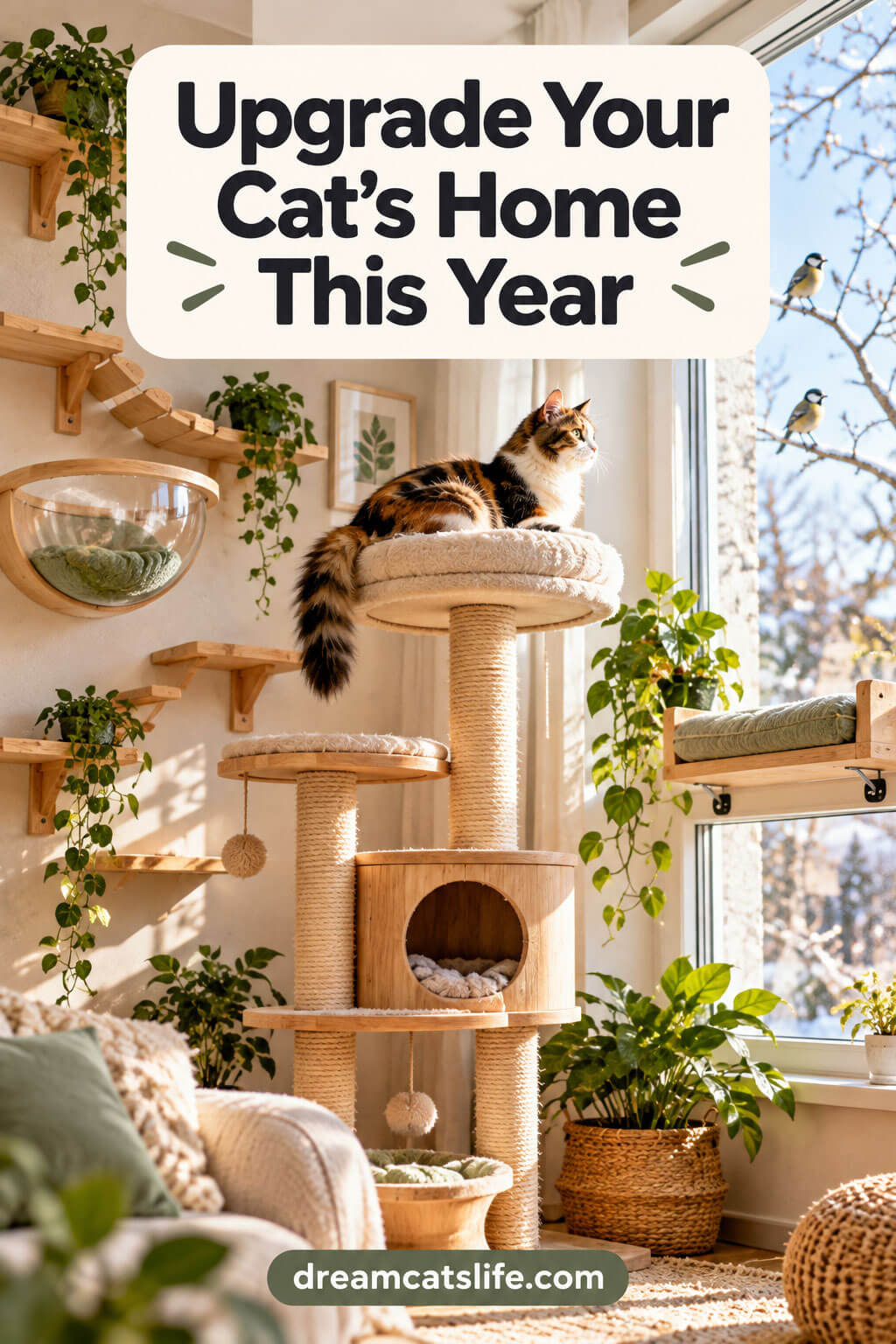
Cats feel safest when they can observe their territory from above. Vertical space is one of the most overlooked ways to improve a cat’s home. It adds usable square footage without taking up floor space, and it’s especially valuable in multi-cat households, where elevated perches help cats avoid conflict.
Options include:
- Cat trees: Look for a sturdy, multi-level cat tree with a wide base so it won’t wobble. Stability matters more than fancy features, because a cat who feels the tree move will avoid it.
- Wall shelves and perches: Create a “cat highway” along a wall using sturdy, properly anchored shelves.
- Window perches: A cozy ledge by the window doubles as entertainment.
- Cleared bookshelf tops or wardrobe tops: Free, and often already beloved.
Place at least one tall structure in a room where your family spends time. Cats like to be near their people, just not in the middle of the action.
Resolution 4: Upgrade Your Scratching Setup
Scratching is a natural, necessary behavior, not misbehavior. Cats scratch to stretch, shed claw sheaths, mark territory with scent glands in their paws, and relieve stress. If you don’t provide good options, they’ll choose their own, usually your couch.
What Makes a Good Scratcher?
- Tall enough for a full stretch (about 30 inches or more for vertical posts).
- Stable. It should not tip or slide when your cat pulls on it.
- Textured with sisal, cardboard, or natural fiber. Many cats prefer sisal rope or fabric for vertical scratching and cardboard for horizontal.
- Located where your cat wants to scratch: near sleeping areas, entryways, and the furniture they already target.
Mistake to avoid: Declawing or punishing scratching. Declawing is a painful amputation that can lead to chronic pain and behavior problems, and punishment only teaches your cat to fear you. Redirect instead: offer a better scratching surface in the same spot, and reward use with praise or treats.
Resolution 5: Perfect the Litter Box Setup
Litter box problems are one of the top reasons cats are surrendered to shelters, and most are fixable. Make this the year you get it right.
- Follow the “n+1” rule: one litter box per cat, plus one extra, placed in different locations.
- Choose a large box. Ideally it should be about one and a half times your cat’s body length. Many standard boxes are too small.
- Scoop at least once daily, and completely replace the litter and wash the box on a regular schedule. Use mild, unscented soap.
- Avoid scented litter and liners if your cat is picky. Most cats prefer unscented, soft-textured litter.
- Pick quiet, accessible locations. Avoid placing boxes next to loud appliances or in cramped, dead-end spots where your cat might feel trapped.
Pro tip: If your cat suddenly starts going outside the box, call your veterinarian first. Urinary tract infections, kidney disease, arthritis, and diabetes can all cause litter box avoidance. Straining, frequent trips with little output, or blood in the urine is an emergency, especially in male cats.
Resolution 6: Make Mealtime More Mentally Stimulating
A bowl of kibble takes seconds to finish. In nature, a cat would spend hours hunting for the same calories. Food puzzles and foraging games turn mealtime into enrichment and can slow down fast eaters.
Start simple. A cat puzzle feeder lets your cat work for part of their meal. Begin with the easiest setting so your cat succeeds quickly, then gradually increase the difficulty. You can also go the DIY route:
- Scatter dry food around a room for a “treasure hunt.”
- Hide small portions on different levels of the cat tree.
- Place kibble in an egg carton or an empty toilet paper tube box.
Keep an eye on portions. Foraging is meant to replace part of a meal, not add calories on top. If your cat is overweight, talk to your vet about the right daily amount.
Resolution 7: Add Sensory Enrichment
You don’t need to spend much to give your cat more to see, smell, and hear.
- Bird feeder outside a window: “Cat TV” is a favorite, and it costs very little.
- Cat-safe plants: Cat grass, catnip, and silvervine are safe options. Always check that any houseplant is non-toxic, since lilies, for example, are extremely dangerous for cats.
- Cardboard boxes: Free, endlessly popular, and a great hiding spot.
- Rotating scents: Introduce a new, safe item, such as a clean cardboard tube or a sprig of cat-safe herb, for fresh sniffing.
Resolution 8: Prioritize Preventive Health Care
Cats are masters at hiding illness, a survival instinct inherited from their ancestors. By the time symptoms are obvious, the problem may be advanced. Preventive care is the most loving resolution you can make.
- Schedule an annual wellness exam, or twice a year for seniors (generally cats over 10) and cats with chronic conditions.
- Check your cat’s weight. Obesity is widespread among pet cats in the U.S. and raises the risk of diabetes, arthritis, and other problems. Ask your vet to score your cat’s body condition.
- Don’t ignore dental health. Dental disease is extremely common in cats. Ask your vet about home care and professional cleanings.
- Stay current on vaccines and parasite prevention as recommended by your veterinarian.
- Confirm microchip and ID details. Make sure your contact information is up to date.
Also, take note of changes: appetite, thirst, litter box habits, grooming, activity level, or vocalization. Small shifts can be the earliest warning signs.
Resolution 9: Try Positive-Reinforcement Training
Yes, cats can be trained, and they often enjoy it. Training provides mental stimulation and builds trust. Short, fun sessions of two to five minutes work best.
Use small, high-value treats and a consistent marker, such as a clicker or a short word like “yes.” Good first behaviors include:
- Come when called (useful in emergencies).
- Sit or “up” on a target spot.
- Go into the carrier voluntarily, which makes vet visits dramatically less stressful.
- Touch a target stick with the nose, which is the foundation for many other tricks.
Never force or scold. If your cat loses interest, end the session on a success and try again later.
Resolution 10: Make Your Home Safer
A new year is a great time for a quick safety sweep:
- Secure window screens and balcony access to prevent falls.
- Remove toxic plants (lilies, sago palm, and others) and keep human medications locked away.
- Hide cords and strings. Chewing on cords and swallowing string, ribbon, or hair ties can cause serious emergencies.
- Keep essential oils and strong cleaners out of reach. Several are toxic to cats.
- Check where your cat sleeps. Make sure the spot is warm, quiet, and draft-free.
Resolution 11: Support Your Cat Through Change and Stress
Cats are creatures of habit, so a move, a new pet, or even rearranged furniture can trigger hiding, over-grooming, or litter box problems. Keep feeding and play times predictable, introduce changes gradually, and make sure your cat always has a safe place to retreat. If stress lingers, ask your vet about calming options.
Resolution 12: Track Your Progress
The reason most resolutions fail is that they’re vague. Make your cat goals specific and measurable. Instead of “play more,” try “play with a wand toy for 10 minutes every evening before dinner.” Mark a calendar, set a phone reminder, or use a habit-tracking app. Celebrate milestones, even if the celebration is simply a new cardboard box.

Common Mistakes That Derail Cat Resolutions
- Trying to do everything at once. Pick three or four resolutions and add more later.
- Buying lots of toys but not playing. Toys are tools; your participation is what makes them work.
- Introducing too many changes simultaneously. New cat tree, new litter, new food, and new schedule in one week is overwhelming. Space changes out.
- Ignoring your cat’s preferences. Every cat is different. Some love laser pointers, others prefer feathers; some adore cuddles, others prefer proximity.
- Assuming behavior problems are “just personality.” Sudden changes often signal a health issue. When in doubt, see your vet.
A Simple Weekly Plan to Get Started
Here’s an easy framework you can adapt to your own schedule:
| Day | Focus | Time |
|---|---|---|
| Monday | Morning and evening wand play | 2 x 10 min |
| Tuesday | Puzzle feeder dinner + brushing | 15 min |
| Wednesday | Play + clicker training | 15 min |
| Thursday | Rearrange toys; add a new box or perch | 10 min |
| Friday | Play + quiet “unplugged” bonding | 20 min |
| Saturday | Home safety check; scratcher refresh | 15 min |
| Sunday | Weigh-in, health notes, deep litter box clean | 20 min |
That’s roughly 15 to 30 minutes a day, a manageable commitment that adds up to a significantly richer life for your cat.
Frequently Asked Questions
How much time should I spend with my cat every day?
There’s no single magic number, but a good target is at least 20 to 30 minutes of focused interaction daily, including two short play sessions. Cats who are alone for long stretches may need more engagement and enrichment.
What are good New Year’s resolutions for cat owners?
Popular and effective options include daily interactive play, an annual vet visit, adding vertical space, improving the litter box setup, using puzzle feeders, and learning cat body language.
How can I get my lazy cat to play?
Try different toy types, movements, and times of day. Many cats respond best to prey-like movement, such as skittering along the floor or fluttering through the air, and are most active at dawn and dusk. For overweight or older cats, start with very short sessions and build slowly. If your cat is suddenly less active, check with your vet.
Is it okay to leave my cat alone all day?
Most adult cats cope with a normal workday if they have food, water, clean litter, safe hiding places, window views, and toys. Play before you leave and again when you return. Kittens and very social cats may benefit from company or a companion cat, but introductions must be done carefully.
How many litter boxes do I need?
The standard guideline is one per cat, plus one extra, in separate locations.
Final Thoughts: Small Habits, Big Difference
Your cat doesn’t need expensive gadgets or a perfect home. What they need is your attention, a stimulating environment, and consistent care. Start small: ten minutes of play tonight, a better scratching spot this weekend, a vet appointment on the calendar by the end of the month.
Cats live in the moment, which means every day you improve their world, they notice. Make this the year you turn “I should” into “we did,” and enjoy a year of more purrs, fewer midnight zoomies, and a deeper bond with the cat who has already chosen you.
This article is for general informational purposes and does not replace professional veterinary advice. If you have concerns about your cat’s health or behavior, consult your veterinarian.