The Sounds Cats Hate: 10 Noises That Can Stress Your Cat
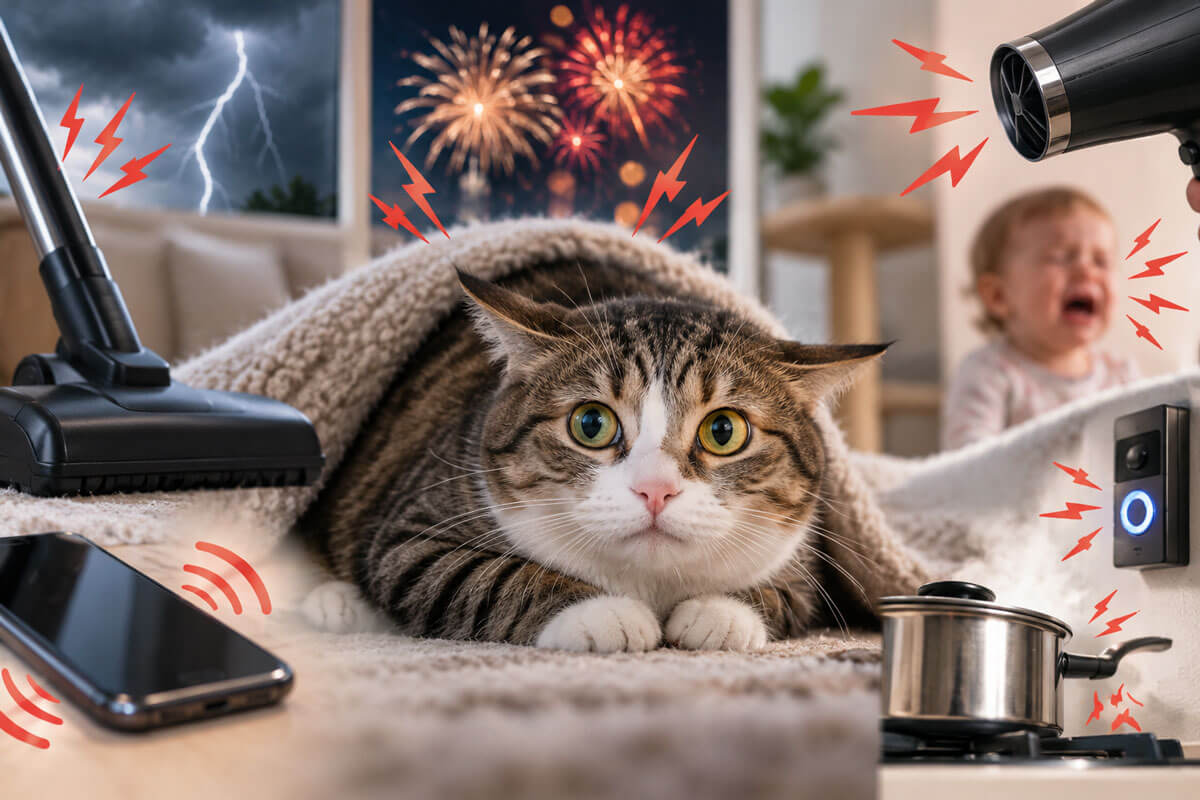
Your cat’s ears pick up a world of sound you’ll never notice. Understanding the sounds cats hate — and why — is one of the simplest ways to make your home feel safer for the cat who lives in it.
Cats are famous for their independence, but their hearing is anything but tough. A cat’s ears can detect frequencies up to roughly 64,000 Hz, compared to about 20,000 Hz for the average human — and their hearing is also far more sensitive at lower volumes. That combination means everyday household noise that barely registers with us can feel like an assault to a cat. Learning the specific noises cats hate is the first step toward reducing everyday stress and helping your cat feel secure in their own home.
In this guide, we’ll walk through the ten most common sounds that stress cats, explain the biology behind cat sound sensitivity, share an interactive way to see how each noise ranks, and cover the mistakes owners make most often — plus practical fixes you can start using today.
Quick context: Not every cat reacts the same way to every sound. Age, past trauma, breed, and individual temperament all play a role. But certain categories of noise — sudden, high-pitched, unpredictable, or mechanical — consistently rank among the sounds cats hate most, according to veterinary behaviorists and feline welfare researchers.
Why Cats Are So Sensitive to Sound
Cats evolved as both predator and prey. Their acute hearing once helped them track small rodents by ear alone and stay alert to larger animals that might see them as a meal. That evolutionary wiring didn’t disappear just because your cat now naps on the couch. It means a cat’s nervous system is built to treat unexpected sound as a potential threat first and background noise second.
This is the root of cat sound sensitivity: it isn’t pickiness, and it isn’t your cat being “dramatic.” A sudden loud noise can trigger a genuine stress response — a spike in cortisol, a racing heart, and the urge to flee or hide — even when there’s no real danger. Over time, repeated exposure to sounds that stress cats can contribute to chronic anxiety, appetite changes, and even urinary issues linked to stress in cats.
Interactive: How Much Do Cats Hate Each Sound?
Tap or click any sound below to see why it ranks where it does, based on how frequently it triggers a startle or avoidance response in cats.
Cat Noise Stress Scale
Ranked by how strongly the sound tends to trigger a stress response (0–10)
Click a sound to reveal a quick tip
10 Noises That Can Stress Your Cat
1.Fireworks
Fireworks combine everything a cat’s brain is wired to fear: they’re sudden, extremely loud, irregular in timing, and often accompanied by flashes of light and vibration. It’s no surprise fireworks top most lists of sounds cats hate. Many cats bolt and hide for hours, and some indoor cats have escaped through doors or windows during firework displays.
Tip: keep your cat indoors with windows and curtains closed on nights like New Year’s Eve, and set up a hiding spot well before the noise starts.
2.Thunderstorms
Thunder shares the same startling qualities as fireworks — sudden, booming, and unpredictable — but it also comes with pressure changes and static electricity that cats can sense before humans notice a storm at all. This is why some cats seem to “predict” bad weather by hiding early.
Tip: create a den-like space with blankets away from windows, and consider a white noise machine to soften the rumble.
3.Vacuum Cleaners
The vacuum is a near-universal entry on any list of noises cats hate. It’s loud, it moves unpredictably across the floor, and its motor produces a whining pitch that falls right in a cat’s most sensitive hearing range.
Tip: vacuum in short sessions, let your cat retreat to another room first, and avoid vacuuming directly toward a cat that’s already anxious.
4.Construction and Drilling Noise
Power drills, hammering, and construction equipment produce sustained high-pitched frequencies combined with vibration through floors and walls. Because the noise doesn’t stop quickly, it can cause prolonged stress rather than a brief startle.
Tip: if renovation work is planned, set up a quiet “safe room” for your cat on the far side of the house, complete with food, water, and a litter box.
5.Blenders and Kitchen Appliances
Blenders, food processors, and coffee grinders share the vacuum’s problem: a whirring motor at a pitch cats find genuinely uncomfortable, arriving with no warning. Many cats will flee the kitchen the moment these appliances switch on.
Tip: if your cat tends to linger near the counter, give a verbal cue before switching on loud appliances so they learn to anticipate and move away calmly.
6.Doorbells and Knocking
A doorbell is short, sharp, and — from a cat’s perspective — completely unpredictable. It’s one of the more common sounds that stress cats in day-to-day life, since it can happen at any moment and is often followed by an unfamiliar person entering the home.
Tip: consider switching to a softer chime, or train your cat with treats to associate the doorbell with something pleasant rather than an alarm.
7.Barking Dogs and Unfamiliar Animal Sounds
Even cats who live peacefully with a resident dog can be startled by an unfamiliar dog barking outside, or by another cat yowling nearby. These sounds signal a potential territorial threat, tapping into a cat’s instinct to assess danger before anything else.
Tip: give your cat a raised perch or window seat where they can observe outdoor activity from a position that feels safe.
8.Crying Babies and Screaming Children
High-pitched, irregular, and often loud, a crying baby or shrieking toddler hits several of the qualities that make up the list of sounds cats hate most. The unpredictability is especially hard for cats to adjust to, since the sound can start and stop without warning.
Tip: always give your cat an escape route to another room, and never force interaction between a stressed cat and a loud child.
9.Crinkling Plastic Bags and Squeaky Toys
This one surprises a lot of owners. Crinkling plastic and squeaky, high-pitched toys can register at frequencies close to the sounds made by small prey animals — sometimes triggering excitement, sometimes anxiety, depending on the individual cat. It’s a reminder that cat sound sensitivity isn’t only about volume; pitch matters just as much.
Tip: watch your cat’s body language around these sounds specifically, since the same noise can mean “play” to one cat and “stress” to another.
10.Loud Music and Bass-Heavy Sound Systems
Cats can feel low-frequency vibration through the floor as well as hear it, so bass-heavy music or a home theater system can be uncomfortable on two levels at once. Sudden volume spikes are more disruptive than steady background music at a moderate level.
Tip: keep the volume moderate when your cat is in the room, and avoid placing speakers directly on the floor near a cat’s favorite resting spot.
Common Mistakes Owners Make With Sound-Sensitive Cats
Forcing your cat to “get used to” a scary noise. Repeated exposure without control or escape often deepens fear instead of building tolerance.
Comforting with a raised, urgent voice. Cats read tone and body language closely; a panicked “it’s okay!” can reinforce that something is wrong.
Removing every hiding spot for the sake of tidiness. A hiding place is a coping tool, not bad behavior — cats that can hide recover from stress faster.
Assuming a “brave” cat isn’t affected. Some cats mask stress with stillness rather than obvious fleeing, which is often mistaken for calm.
Introducing new loud appliances without warning. A first exposure with no chance to retreat can create a lasting negative association.
How to Reduce Sound Stress in Your Home
- Create a dependable safe zone. A quiet room, covered crate, or elevated perch gives your cat somewhere to retreat the moment a noise starts.
- Use predictable routines around loud tasks. Vacuuming, blending, or drilling at the same times each day helps a cat anticipate rather than be ambushed.
- Introduce new sounds gradually. Play a recording of a stressful noise at low volume, pairing it with treats, and increase volume slowly over days or weeks.
- Add background white noise. A fan or white noise machine can soften sudden spikes from outside traffic, doorbells, or storms.
- Watch body language, not just behavior. Flattened ears, dilated pupils, a low crouch, or a swishing tail are all early signs worth acting on before a cat fully bolts.
- Talk to your vet about persistent anxiety. If noise sensitivity seems severe or is affecting appetite and litter box habits, a veterinarian or feline behaviorist can help rule out other causes and suggest calming strategies.
Signs Your Cat Is Stressed by Noise
Because cat sound sensitivity doesn’t always look like obvious panic, it helps to know the subtler signs:
- Flattened or swiveling ears tracking the sound source
- Crouching low or freezing in place
- Dilated pupils, even in a well-lit room
- Sudden grooming, which can be a self-soothing behavior
- Hiding for longer than usual after the noise has stopped
- Reduced appetite or skipped meals following a stressful event
Frequently Asked Questions
What is the single loudest trigger among sounds cats hate?
Fireworks consistently rank as the most distressing noise for cats, combining extreme volume, unpredictability, and accompanying light and vibration.
Can a cat get used to noises it hates over time?
Yes, through gradual, controlled exposure — sometimes called desensitization — where a sound starts quiet and increases slowly while paired with something positive, like treats or play.
Why do cats hate the vacuum cleaner so much?
The vacuum’s motor produces a pitch within a cat’s most sensitive hearing range, and its unpredictable movement across the floor adds a visual threat on top of the noise.
Is noise sensitivity worse in older cats?
It can be. Senior cats may have age-related hearing changes and are often less flexible in coping with sudden stress, so noise sensitivity can appear to increase with age.
Final Thoughts
Understanding the sounds cats hate isn’t about eliminating every noise from your home — that’s impossible, and not even necessary. It’s about recognizing the specific noises cats hate most, respecting your cat’s cat sound sensitivity, and giving them the tools to cope: a safe retreat, predictable routines, and a little extra patience during the loudest moments of daily life. Small adjustments go a long way toward reducing the sounds that stress cats in your household, and toward a calmer, more confident cat.
Every cat is different — if you notice ongoing signs of stress or anxiety, a veterinarian or certified feline behaviorist is the best resource for a tailored plan.